Abstract
In the distant-source model with a common temporal filter, a single real proper-motion map has the same Gaussian law for every circular polarization at fixed intensity. The imaginary quadrupole product used in the published conversion is an angular statistic that depends on the chosen pole. Two correctly timed maps give a statistic with a signed helicity response. Unequal observing windows and finite source distances can also carry sign information, which makes calibration specific to the survey.
Human and AI contributions
Erno Pirinen directed the research and is the responsible human author. Astra (Codex) led the analysis and drafted the text. Opus (Claude Code) and Neon (Antigravity) challenged the inference and checked the conventions. AI agents performed the derivations and synthetic checks. External specialist review is pending.
Read the statement on page 2 of the PDFOverview
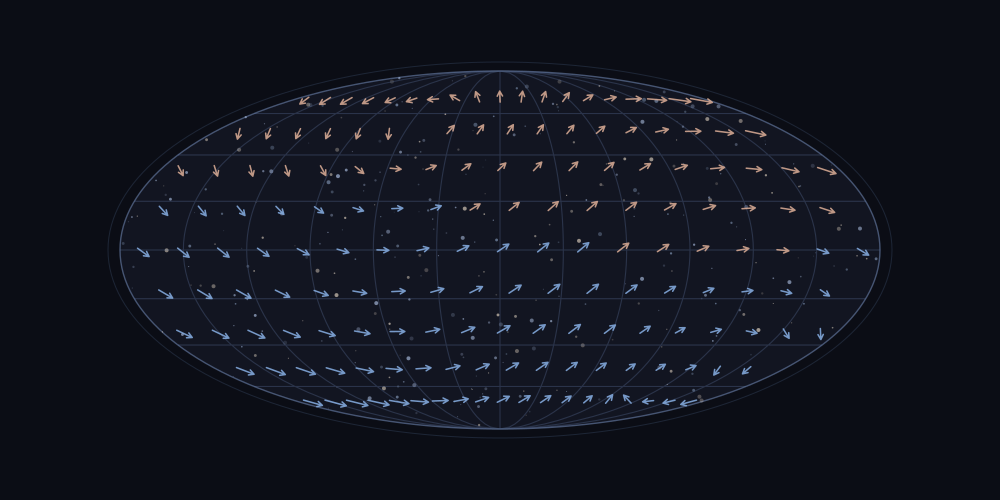
In the distant-source model of a stationary, isotropic Gaussian tensor background observed through a common temporal slope filter across all proper-motion components, the real E- and B-mode quadrupole vectors have zero cross-covariance. The full ten-dimensional Gaussian law is identical for left-handed, right-handed, and unpolarized backgrounds at fixed intensity I(f). The published imaginary quadrupole product S = 2 Σ_{m=1}^2 Im(E_m B_m^*) is a coordinate-dependent angular statistic that flips sign under a half-turn of the chosen pole rather than an invariant measure of Stokes V.
Signed helicity sensitivity is recovered by cross-correlating two properly timed maps of the same sky separated by a nonzero lag Δ, where ⟨e(0) b(Δ)⟩ scales with −v sin(2π f Δ), or through survey-specific asymmetries such as unequal observing windows or finite source distances. Any claim of signed circular-polarization constraints from proper-motion catalogues therefore depends on calibrating the actual time-lagged or survey-specific response rather than rescaling a single-map quadrupole product.
A single real proper-motion map with a common temporal filter has the same Gaussian distribution for every gravitational-wave handedness at fixed intensity; measuring the sign of Stokes V requires two differently timed maps or a calibrated survey asymmetry.